
Chinese Fragrance Houses on Export Markets: A Vegan Scope Check
A vegan-positioned brand briefing a Chinese fragrance house is not really buying a scent; it is buying a defined scope with an ingredient story attached. The brands that avoid surprises treat that scope as a document rather than a conversation: what is developed, what is tested, what is written down, and who owns each decision. Work through the six areas below before the first sample round, and most of the arguments that normally surface at the bulk stage never happen.
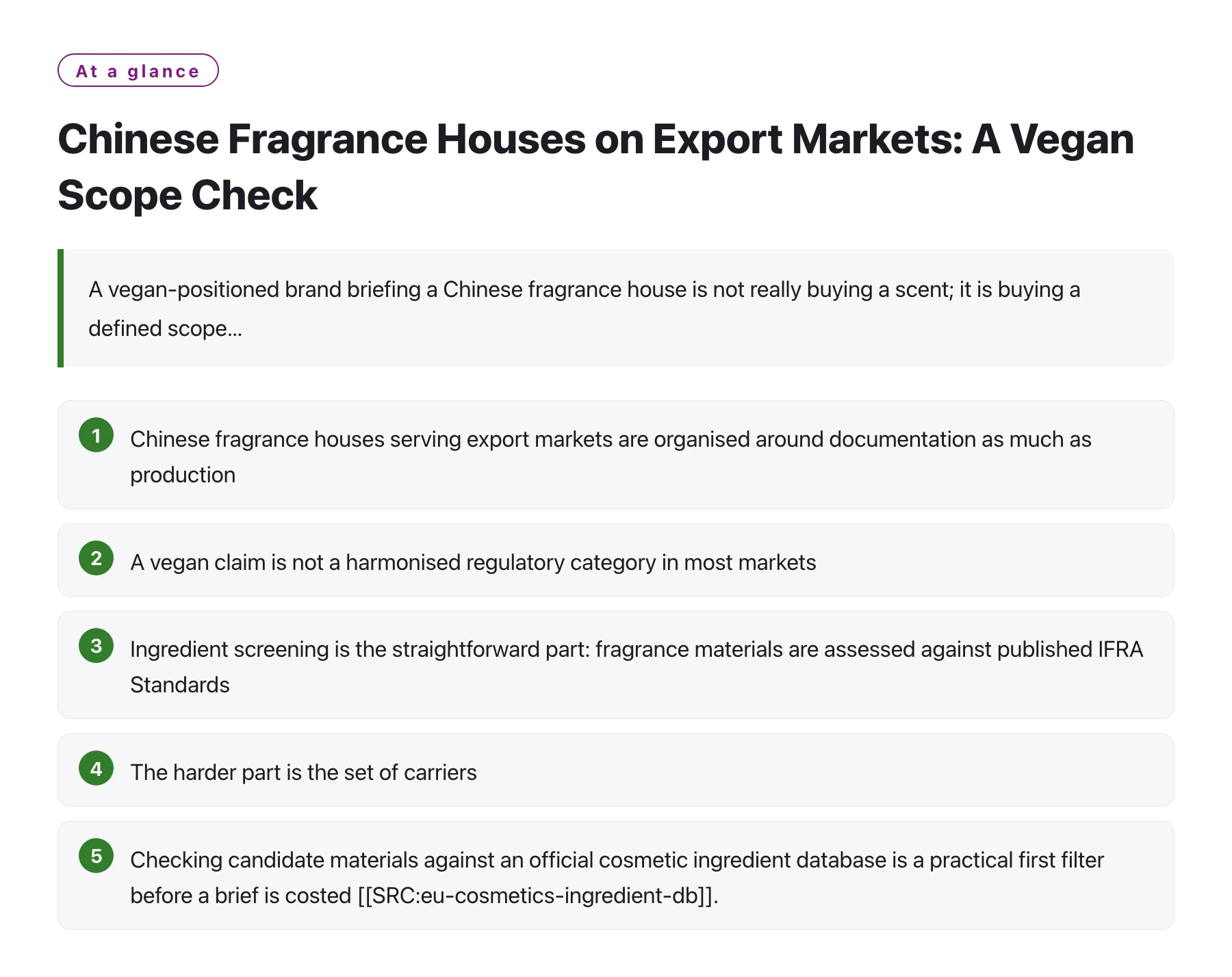
Key takeaways
- Chinese fragrance houses serving export markets are organised around documentation as much as production, so the scope conversation should start with what can be evidenced rather than what can be promised.
- A vegan claim is not a harmonised regulatory category in most markets, which means the brand, not the factory, has to define what the claim means across its own supply chain.
- Ingredient screening is the straightforward part: fragrance materials are assessed against published IFRA Standards, and that assessment applies regardless of a brand's positioning [1].
- The harder part is the set of carriers, solvents and process aids that sit around the fragrance, which is where a vegan scope usually needs its most explicit wording.
- Checking candidate materials against an official cosmetic ingredient database is a practical first filter before a brief is costed [2].
Most sourcing guides for Chinese perfume brands begin with price and minimum order quantity. Those questions matter, but they come second. The scope of what a supplier will develop, test, document and hand over determines whether the project holds its schedule, and for a vegan-positioned brand that scope has a second dimension that many briefs never define.
This checklist is written for a product development lead preparing a first brief. It is deliberately about boundaries rather than capabilities, because capability claims are easy to make and scope boundaries are what a contract can actually enforce.
Six scope areas and the wording that protects a claim
| Scope area | What to put in writing | Why a vegan brand should care |
|---|---|---|
| Ingredient screening | Which materials are excluded, by name or by class, and who signs off on substitutions | Exclusions are real only when they are written into the specification instead of agreed by email |
| Documentation set | The certificates of analysis, safety documents and stability records that travel with each batch | A claim that cannot be traced to a document is a marketing statement rather than a supply chain fact |
| Sampling rounds | How many rounds are included, what counts as a new round, and the turnaround for each one | Vegan alternatives for a carrier or fixative often need an extra round to match the original scent |
| Packaging components | Which components are in scope, and whether closures, pumps and inserts follow the same rule set | Non-fragrance parts are a frequent location for undisclosed animal-derived inputs such as some adhesives and finishes |
| Testing | Which tests the destination market requires and which are optional, and who commissions each | Testing scope drives both cost and lead time, and it can differ between markets inside one launch |
| Ownership | Who owns the formula, the tooling and the test data once the order closes | Ownership decides what you can take with you if you change supplier later |
The third column is the reason a vegan brand should not inherit a generic brief. Every scope line has a second question attached, and that second question is usually answered by the brand rather than by the factory.
What a Chinese fragrance house actually covers
The phrase covers a wide range of businesses, from trading offices that broker work to factories that compound, fill and package on one site. The practical difference appears in how many hands a brief passes through. When development, compounding and filling sit with one partner, a change to an ingredient list becomes a change to one production plan. When they are split, the same change becomes a set of instructions that has to be re-sent, re-confirmed and re-documented.
This is why many conversations about Chinese perfume brands are really conversations about vertical scope. A brand that knows which steps are in-house can predict where delays and documentation gaps will appear, and can ask for the handover points to be written down rather than described.
A useful test in a first meeting is to ask what happens to a batch that fails an in-process check. An answer that describes a documented deviation process and a defined disposition decision is a reasonable signal that the scope is understood internally rather than improvised per order.
It is also worth clarifying which party owns the destination market paperwork. Some factories prepare standard export documentation as a matter of routine, while market-specific requirements are usually mapped by the importer or the brand's regulatory contact. Confirming this early avoids the common situation where both sides assume the other is handling a requirement.
A five-step scope review before you commit
- Step 1: Write the exclusion list in your own wordsState what must not appear in the product, including carriers and process aids, then ask the supplier to confirm each item in writing rather than on a call.
- Step 2: Ask for a document sample, not a document listRequest one real certificate of analysis and one stability summary from a recent batch, with commercial details removed, so the format and completeness can be judged.
- Step 3: Map the handover pointsMark where development ends, where bulk begins and where packaging takes over, and name the person accountable at each boundary.
- Step 4: Fix the change rule before the first sampleAgree what happens to cost and timing when the ingredient list or the pack changes, because on a vegan line the first substitution is usually the first real test of the relationship.
- Step 5: Agree the evidence packDecide which documents a retailer or importer will receive on a contract perfume manufacturing in China order, in what format, and how quickly after shipment, so every batch is supported by the same paperwork.
Ingredient boundaries, heritage materials and the claim itself
Chinese perfumery has a deep material vocabulary, and many of the notes that give a Chinese fragrance its character are plant-based by nature. Materials such as Xuelei sit comfortably inside a vegan specification. The complications are rarely the headline note; they are the supporting cast.
Fixatives, solvents, colourants and the finishes applied to a bottle or cap are where a vegan specification earns its keep. Asking for a full ingredient declaration for every component in the pack, not only the juice, is the single most useful request a vegan brand can make at scope stage.
The second boundary is the claim itself. Because vegan labelling is not harmonised across markets, the brand usually has to define the claim and then defend it. That defence rests on the supplier's documentation, so the scope review should end with a simple question: if a retailer asks for evidence, what exactly will be handed over, and by whom?
For companies that want to see how a long-established manufacturer presents its own background and certification set, a Chinese fragrance manufacturer since 1994 is a reasonable reference point. The same questions should still be asked directly of whichever partner is shortlisted.
Keep the export route in view as well. Customs, labelling and market-specific documentation all sit on the timeline, and they are easier to plan when the scope document separates product work from paperwork work.
A vegan scope that lives only in a brief is a wish. Convert it into three artefacts before sampling starts: an exclusion list with a named owner, a document set with a real sample attached, and a written change rule. Those three artefacts are what make the claim auditable months later.
Sources
- IFRA Standards Library (International Fragrance Association) —— The IFRA Standards Library lists the restrictions the fragrance industry applies to individual fragrance ingredients, based on safety assessments; it is the reference point for compliant fragrance formulation.
- EU CosIng — Cosmetic Ingredient Database (European Commission) —— The European Commission's CosIng database of cosmetic ingredients, listing ingredient functions, restrictions and labelling requirements under EU cosmetics law.
Frequently asked questions
Do Chinese fragrance manufacturers understand vegan requirements?
Many do, but understanding is not the same as a documented process. Ask how exclusions are recorded and how substitutions are approved. A supplier that can show a written specification with named exclusions is in a different position from one that answers verbally and moves on.
Is a vegan fragrance automatically cruelty-free?
No. The two claims cover different things. A vegan claim concerns ingredients and, depending on how the brand defines it, processing aids. Cruelty-free concerns testing history. A brand intending to make both claims should define each one separately and ask for separate evidence.
Where do animal-derived materials most often hide in a perfume project?
Rarely in the main accord. The usual locations are the supporting materials, the solvent system, and components around the juice such as certain finishes, adhesives and applicator materials. That is why the pack belongs in the scope review rather than in a later packaging conversation.
Should an exclusion list name materials or classes of materials?
Both, for different reasons. Named materials are unambiguous, while classes cover the substitutions a factory might otherwise make during production. Naming classes also gives the supplier a clear basis for proposing an alternative instead of silently swapping one material for another.
How should a brand verify that the agreed scope was followed?
By tying every claim to a document. Batch records, certificates of analysis and stability summaries should be issued per batch, and the brand should spot-check that the documents match the units actually shipped rather than the specification that was first quoted.
A Quiet Invitation
Ready to turn the next chapter into a plan?
Book a free 30-minute discovery call. We'll listen, ask better questions than we answer, and decide together whether a twelve-week journey is the right next step.
Book Your Free Discovery Call