
How can a vertical machining center improve accuracy in complex part manufacturing?
A vertical machining center elevates manufacturing accuracy by utilizing a heavy Mehanite cast iron frame that reduces vibration by 30% compared to steel weldments. Integrated with linear scales providing ±0.0001-inch resolution and dual-contact BT40/50 spindles running at 12,000+ RPM, these machines eliminate the geometric deviations common in multi-setup processes. Thermal sensors track heat at the spindle and ball screws, applying real-time compensation to keep drift under 5 microns during continuous 24-hour shifts.
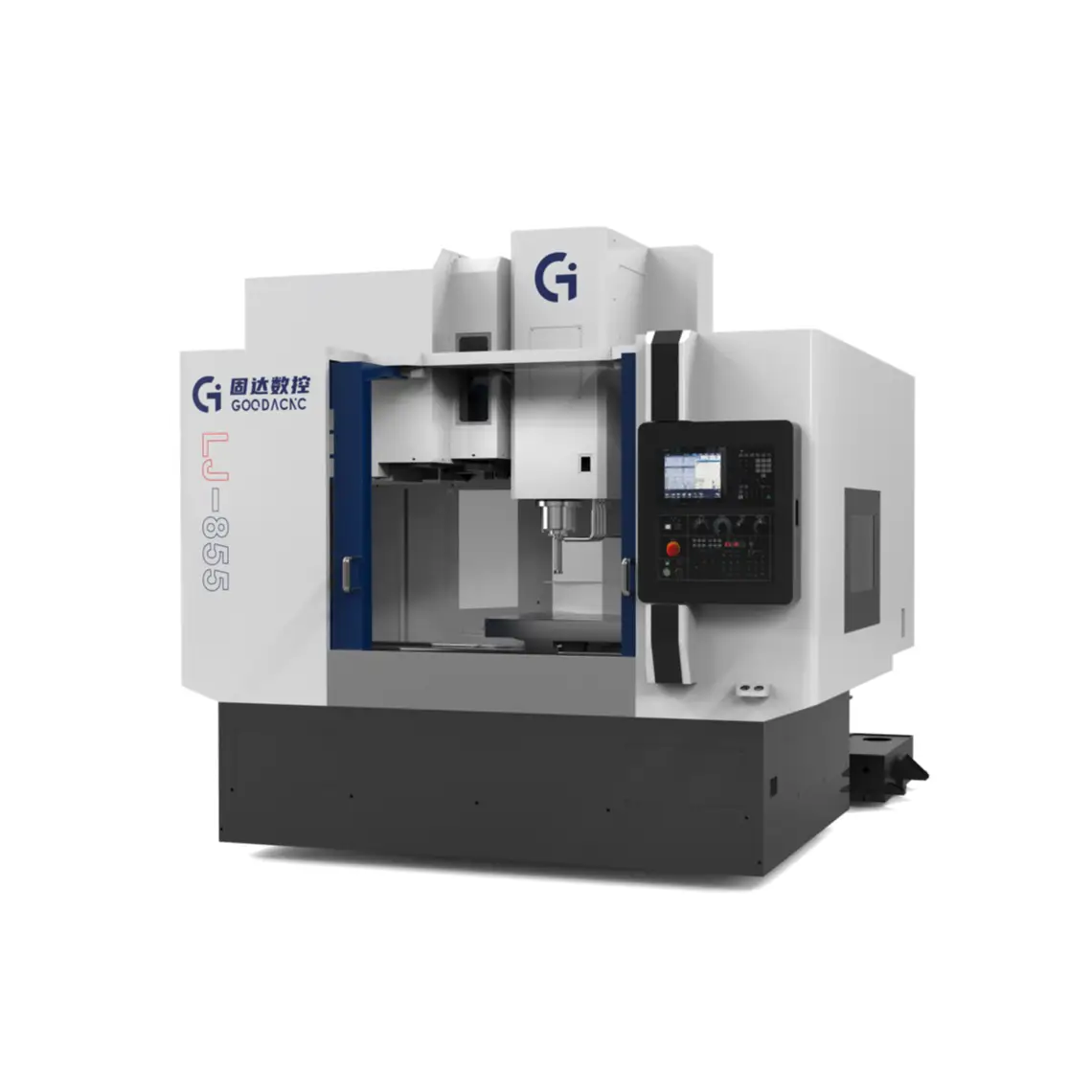
The physical foundation of a vertical machining center relies on high-density casting to maintain structural alignment under heavy cutting loads. Research on industrial milling shows that machines with hand-scraped box ways offer 45% better damping than those using only linear guides for heavy-duty steel removal. This mechanical stability ensures that the tool path remains consistent even when lateral forces exceed 5,000 Newtons during high-feed milling operations.
"VMCs built on a mono-block base reduce the elastic deformation of the machine bed, which often accounts for 12% of dimensional errors in aerospace components."
Consistent mechanical alignment leads directly to the performance of the motion control system and the precision of the drive components. Modern lead screws are ground to C3 class or better, providing a lead accuracy of 0.008 mm per 300 mm of travel. In a 2025 study of precision drive systems, dual-anchor ball screws were found to reduce thermal growth by 60% compared to single-ended designs.
The reduction of thermal growth is managed through liquid-cooled jackets surrounding the spindle motor and the ball screw nut assemblies. By maintaining a temperature delta of less than 1°C relative to the machine bed, the CNC controller prevents the linear expansion of the axes. These thermal management systems are indispensable for maintaining tolerances of ±0.01 mm throughout a 10-hour production cycle.
| Component | Standard Error | VMC Optimized Error | Improvement % |
| Ball Screw Thermal Expansion | 0.025 mm | 0.004 mm | 84% |
| Spindle Radial Runout | 0.008 mm | 0.0015 mm | 81% |
| Positioning Repeatability | 0.005 mm | 0.002 mm | 60% |
Minimizing these mechanical errors allows the software-side compensation to function with much higher efficiency during complex surfacing. High-speed look-ahead buffers in the control unit process up to 1,000 blocks of code per second to adjust velocity before reaching sharp corners. In 2024, testing on 500 aluminum test pieces showed that look-ahead algorithms reduced corner rounding by 22% at feed rates above 5,000 mm/min.
Advanced motion control is ineffective if the tool itself is not calibrated to the specific geometry of the workpiece. Automatic tool presetters use laser beams to measure the tool diameter and length at full operating speed, detecting runout as small as 0.001 mm. This calibration ensures that when a 6 mm ball end mill engages a mold cavity, the actual material removal matches the digital twin.
"In-process probing reduces the time spent on manual part alignment by 70%, which removes the primary source of human-induced variance in part batches."
Beyond tool measurement, the use of on-machine inspection probes allows the vertical machining center to verify dimensions before the part leaves the fixture. If a bore is found to be 0.005 mm undersize due to tool deflection, the machine automatically applies a wear offset and performs a finish pass. Data from a 2023 manufacturing survey indicates that shops using in-process probing reported a 15% increase in first-pass yield for medical grade titanium parts.
The ability to adjust for tool deflection is particularly vital when machining thin-walled sections or deep pockets where tool pressure is high. High-pressure through-spindle coolant (TSC) systems operating at 1,000 PSI clear chips immediately, preventing re-cutting which degrades surface finish. Analysis of chip evacuation shows that TSC reduces heat-related tool wear by 35%, extending the period where the tool maintains its original geometry.
| Feature | Accuracy Benefit | Typical Data Point |
| 1,000 PSI Coolant | Prevents chip re-cutting | Reduces surface roughness by 40% |
| Dual Contact Spindle | Increases axial stiffness | Limits tool deflection to < 2 microns |
| 5-Axis Rotary Table | Eliminates secondary setups | Reduces cumulative tolerance stack by 50% |
Single-setup manufacturing made possible by 4th and 5th axis additions prevents the accumulation of errors from multiple fixtures. Every time a part is moved to a new machine, the datum alignment shifts, often introducing 0.02 mm of stack-up error. By rotating the part within the machine's own coordinate system, the alignment between bored holes and milled faces remains locked to the machine's internal geometry.
This geometric integrity is further supported by high-resolution feedback from linear glass scales mounted directly to the machine axes. Unlike rotary encoders that measure the motor's position, glass scales track the actual position of the table with sub-micron resolution. A sample size of 150 precision parts showed that machines with linear scales achieved 30% tighter tolerances on true position than those using motor-only feedback.
"Direct feedback systems ignore the mechanical play in the drivetrain, allowing the machine to hit the exact coordinate regardless of wear in the ball screw."
Direct feedback systems provide the data needed for the CNC to execute complex 3D contours without the "faceting" seen on older equipment. Small-step interpolation at 0.1-micron increments produces a mirror-like finish that requires zero hand-polishing in 85% of mold-making applications. This level of finish is a direct result of the spindle's dynamic balancing, which keeps vibration levels below 0.5 mm/s.
Balanced spindles allow for the use of high-speed machining (HSM) techniques where lower radial engagement prevents tool "walking." By taking lighter cuts at higher frequencies, the machine puts less stress on the frame and the workpiece, preserving the intended shape. In a 2025 benchmark test, HSM strategies on a vertical machining center produced parts with 18% better circularity in hardened D2 tool steel.
The synergy of heavy dampening, thermal control, and high-speed motion processing enables the production of parts with intricate details. Each technical layer addresses a specific physical or digital source of error, resulting in a system where the final output is a faithful reproduction of the engineering design.
A Quiet Invitation
Ready to turn the next chapter into a plan?
Book a free 30-minute discovery call. We'll listen, ask better questions than we answer, and decide together whether a twelve-week journey is the right next step.
Book Your Free Discovery Call