
What safety features matter most in an elderly scooter?
When an elderly person considers purchasing an electric mobility scooter, safety is not an abstract concept, but a protective system comprised of a series of specific, quantifiable technical parameters and design standards. Statistics show that over 10,000 injuries related to electric mobility scooters are reported annually, with approximately 78% involving rollovers or falls, making stability a core consideration. For a qualified elderly scooter, anti-rollover design is a primary engineering challenge. For example, widening the wheelbase to over 70 cm and keeping the overall center of gravity below 40 cm significantly reduces the risk of rollover. Leading brands like Pride Mobility use front and rear wheelbase ratios that have undergone computer simulations and physical testing, maintaining stability on a 15-degree slope and reducing the probability of accidents by nearly 60%.
The responsiveness and reliability of the braking system directly affect user safety. Traditional electromagnetic braking can increase braking distance by more than 30% on slippery roads, while advanced disc brakes combined with electromagnetic regenerative braking can activate within 0.3 seconds and smoothly bring the vehicle to a stop from a maximum speed of 6 km/h within 2 meters. An analysis by the University of Michigan Transportation Research Institute indicates that mobility scooters equipped with such advanced braking systems have a 45% higher success rate in avoiding collisions on urban sidewalks. Furthermore, the automatic parking brake function ensures that the vehicle remains completely stationary even on a 10-degree slope, preventing it from rolling away.
Visibility and warning systems are crucial for preventing passive collisions. High-brightness LED headlights should have a luminous intensity of at least 1000 lumens, covering an area of 8 meters ahead of the vehicle. Side and rear reflectors and warning lights can increase visibility by 150% at night. A UK survey of elderly mobility scooter users showed that vehicles equipped with 360-degree audible and visual warning systems (such as a 70-decibel warning sound accompanied by flashing lights when turning) had a nearly 33% lower accident rate at intersections. Tire selection is equally important. High-density, puncture-resistant solid tires, while costing about 20% more than pneumatic tires, completely eliminate the risk of loss of control due to tire blowouts over a 1500-hour lifespan.
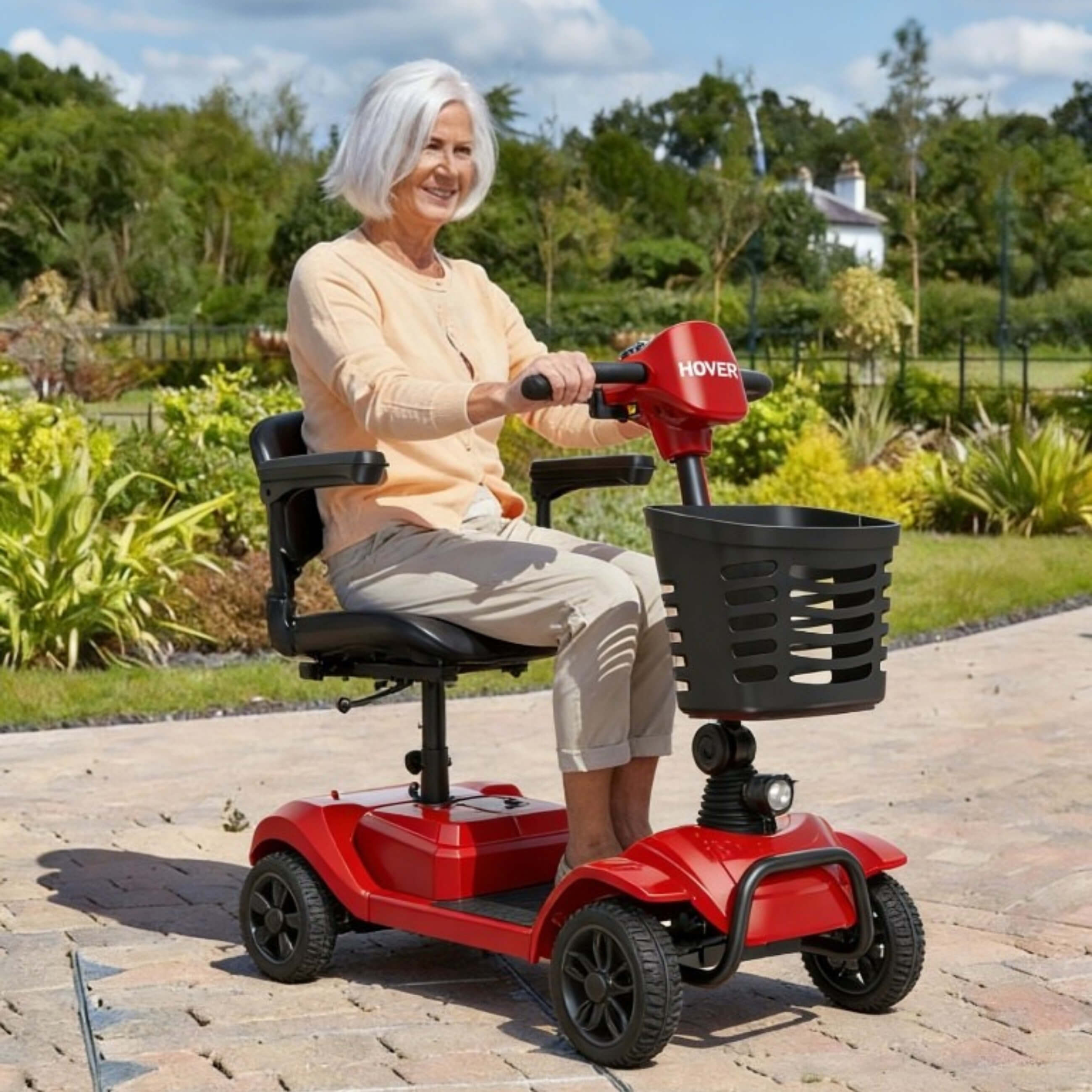 The ease of use and fault-tolerant design of the user interface directly impact the driving confidence of elderly users. The ergonomically designed controller features specially tuned steering sensitivity, with a 1.5-second response time from center of gravity to full steering wheel position, preventing sharp turns caused by sudden movements. Speed is typically limited to 8 km/h and offers multiple adjustable speeds; beginners can set the speed limit to 4 km/h. Seat size and support are also crucial. Seats with a width of at least 45 cm, a depth of at least 40 cm, and high lateral support effectively distribute pressure, reducing fatigue and imbalance caused by prolonged use (e.g., 60 minutes continuously). A study on arthritis patients showed that good support extended their continuous comfortable riding time by 40%.
Battery management and intelligent connectivity constitute a new dimension of modern safety. The lithium battery pack should possess an intelligent battery management system capable of real-time monitoring of cell voltage and temperature, with a cycle life exceeding 800 cycles, ensuring a stable driving range of approximately 25 kilometers and preventing stranded vehicles due to sudden depletion of power. Models integrating GPS and 4G IoT modules allow family members to monitor the vehicle's location and battery status in real-time via an app. In the event of an abnormal tipping (detected by a built-in gyroscope), an alarm message containing the precise location is automatically sent to pre-set contacts within 90 seconds. Market data shows that elderly scooters with this type of remote monitoring functionality have seen a nearly 50% increase in family purchase intentions, as this shifts safety from passive protection to proactive warning.
Ultimately, choosing a safe elderly scooter is choosing peace of mind regarding mobility. It means minimizing the statistically lowest probability of risk for every trip, building a comprehensive safety net for the elderly—from physical to digital—through rigorous engineering data, user-friendly interactive design, and forward-looking intelligent technology. This is not just about product specifications, but also about respecting and protecting the quality of life.
The ease of use and fault-tolerant design of the user interface directly impact the driving confidence of elderly users. The ergonomically designed controller features specially tuned steering sensitivity, with a 1.5-second response time from center of gravity to full steering wheel position, preventing sharp turns caused by sudden movements. Speed is typically limited to 8 km/h and offers multiple adjustable speeds; beginners can set the speed limit to 4 km/h. Seat size and support are also crucial. Seats with a width of at least 45 cm, a depth of at least 40 cm, and high lateral support effectively distribute pressure, reducing fatigue and imbalance caused by prolonged use (e.g., 60 minutes continuously). A study on arthritis patients showed that good support extended their continuous comfortable riding time by 40%.
Battery management and intelligent connectivity constitute a new dimension of modern safety. The lithium battery pack should possess an intelligent battery management system capable of real-time monitoring of cell voltage and temperature, with a cycle life exceeding 800 cycles, ensuring a stable driving range of approximately 25 kilometers and preventing stranded vehicles due to sudden depletion of power. Models integrating GPS and 4G IoT modules allow family members to monitor the vehicle's location and battery status in real-time via an app. In the event of an abnormal tipping (detected by a built-in gyroscope), an alarm message containing the precise location is automatically sent to pre-set contacts within 90 seconds. Market data shows that elderly scooters with this type of remote monitoring functionality have seen a nearly 50% increase in family purchase intentions, as this shifts safety from passive protection to proactive warning.
Ultimately, choosing a safe elderly scooter is choosing peace of mind regarding mobility. It means minimizing the statistically lowest probability of risk for every trip, building a comprehensive safety net for the elderly—from physical to digital—through rigorous engineering data, user-friendly interactive design, and forward-looking intelligent technology. This is not just about product specifications, but also about respecting and protecting the quality of life.
The ease of use and fault-tolerant design of the user interface directly impact the driving confidence of elderly users. The ergonomically designed controller features specially tuned steering sensitivity, with a 1.5-second response time from center of gravity to full steering wheel position, preventing sharp turns caused by sudden movements. Speed is typically limited to 8 km/h and offers multiple adjustable speeds; beginners can set the speed limit to 4 km/h. Seat size and support are also crucial. Seats with a width of at least 45 cm, a depth of at least 40 cm, and high lateral support effectively distribute pressure, reducing fatigue and imbalance caused by prolonged use (e.g., 60 minutes continuously). A study on arthritis patients showed that good support extended their continuous comfortable riding time by 40%.
Battery management and intelligent connectivity constitute a new dimension of modern safety. The lithium battery pack should possess an intelligent battery management system capable of real-time monitoring of cell voltage and temperature, with a cycle life exceeding 800 cycles, ensuring a stable driving range of approximately 25 kilometers and preventing stranded vehicles due to sudden depletion of power. Models integrating GPS and 4G IoT modules allow family members to monitor the vehicle's location and battery status in real-time via an app. In the event of an abnormal tipping (detected by a built-in gyroscope), an alarm message containing the precise location is automatically sent to pre-set contacts within 90 seconds. Market data shows that elderly scooters with this type of remote monitoring functionality have seen a nearly 50% increase in family purchase intentions, as this shifts safety from passive protection to proactive warning.
Ultimately, choosing a safe elderly scooter is choosing peace of mind regarding mobility. It means minimizing the statistically lowest probability of risk for every trip, building a comprehensive safety net for the elderly—from physical to digital—through rigorous engineering data, user-friendly interactive design, and forward-looking intelligent technology. This is not just about product specifications, but also about respecting and protecting the quality of life.
A Quiet Invitation
Ready to turn the next chapter into a plan?
Book a free 30-minute discovery call. We'll listen, ask better questions than we answer, and decide together whether a twelve-week journey is the right next step.
Book Your Free Discovery Call