
Custom 925 Silver Jewelry: Rhodium and Gold Plating
Silver plating is a decision about layer order, not about colour alone. Rhodium gives a white, hard surface; 14K, 18K and 24K gold give three distinct warm tones; an anti-tarnish e-coat adds a protective pass. Each choice changes the tank sequence behind a 50-piece order, and each one needs a care instruction that matches what was actually applied.

Key takeaways
- Four published finishes — rhodium and 14K, 18K, 24K gold — mean four different tank routes for the same silver blank.
- Rhodium over silver is a two-metal stack; the white colour is a coating, not the alloy.
- A 50-piece run needs 50 clean polishes before plating, because a scratch under the deposit cannot be plated out.
- The waterproof claim in the published material belongs to 316L stainless with PVD, not to plated silver.
Why silver needs a top coat at all
925 sterling silver is 92.5% silver, and the copper in the remaining 7.5% reacts with sulphur compounds in air, skin oils and some fabrics. The result is the brown-black film most people call tarnish. It is a surface reaction, which is why it can be removed by polishing and why a barrier layer prevents it in the first place.
A barrier works by keeping the silver away from the air. Rhodium, gold and an anti-tarnish e-coat all do that job in different ways: the metals are deposited in a plating bath, while the e-coat is an organic film cured over the surface. The choice between them is a choice about colour, wear and cost, and the three trade off against each other.
What none of them do is change the metal underneath. A rhodium-plated silver ring is still a silver ring; a gold-plated silver ring is still silver in the core. This matters for resale, for repair and for any claim made at the counter, because the substrate is what a jeweller's torch will meet if the piece is ever resized.
That is also why the finish should be recorded on the order. Two suppliers can both describe a ring as "gold plated" while running different layer stacks, and the difference shows up after a month of daily wear rather than in the sample photograph.
Rhodium: a white surface over a white metal
Rhodium is a platinum-group metal, deposited from its own bath and normally applied thin. It reads cooler and whiter than polished silver, which is why it is used to give a consistent white finish across a collection that mixes cast and hand-finished parts.
The practical advantage is hardness. Rhodium resists the fine scratching that dulls an unplated silver surface in a display case, so a rhodium finish keeps its sheen through handling and shipping. The practical limit is that a thin deposit wears through at high-contact points such as a ring's outer edge or a clasp, and once it does, the warmer silver tone appears underneath.
Layer order matters more than thickness here. Rhodium bonds poorly to a contaminated surface, so the sequence is polish, clean, activate, plate. A wholesale 925 silver jewelry factory that runs its own polishing line controls the interval between those steps, which is where most adhesion failures are introduced.
Rhodium also changes the repair path. A resized ring needs the joint refinished and replated, and the plater has to match a white finish rather than a gold tone. Buyers who plan a repair programme should ask whether replating is offered and what the minimum quantity is for a refinishing batch.
Gold on silver: karat, colour and the layer beneath
The gold options are quoted as multi-layer 14K, 18K and 24K, and each reads differently against silver. Fourteen-karat deposits lean pale and slightly green; 18K sits warmer; 24K is the deepest yellow and the softest of the three. None of them is a solid gold product, and the karat describes the plating alloy rather than the piece.
Multi-layer means more than one pass. A common stack is a thin strike layer for adhesion, a colour layer that carries the karat, and a top pass for wear. Each pass is a separate tank and a separate rinse, so a three-layer gold finish consumes roughly three times the plating time of a single deposit on the same blank.
Anti-tarnish e-coating is listed for silver and brass, and it can sit over a gold deposit as a final seal. That adds a fourth pass and a curing step. The benefit is a slower tarnish cycle on the exposed silver at edges; the cost is one more stage where dust or a handling mark can spoil the surface.
The order should therefore name the stack, not the colour. "18K gold" is a colour instruction; "18K gold over a strike layer, sealed with e-coat" is a process instruction, and only the second can be repeated by a second factory or audited against a complaint.
What to fix before the first tank pass
Plating amplifies whatever the base looks like. A polishing scratch, a solder seam or a casting pit stays visible under a deposit and becomes more obvious under a bright finish. That is why the specification has to start one step earlier than the plating line.
| Finish | Colour | Structure | Care wording |
|---|---|---|---|
| Rhodium | Cool white | Silver base, rhodium deposit | Wipe after wear, avoid abrasive cloths |
| 14K gold | Pale warm | Strike layer, 14K colour layer | Keep away from chlorine and perfume |
| 18K gold | Warm yellow | Strike layer, 18K colour layer, top pass | Store dry, separate from harder pieces |
| 24K gold | Deep yellow | Strike layer, 24K colour layer | Handle edges gently, expect softening with wear |
| E-coat only | Silver tone | Polished silver plus cured film | No ultrasonic cleaning, no hot water |
Two entries in that table carry more risk than the rest. The 24K option has the strongest colour and the softest surface, so it suits pendants and earrings more than ring bands. The e-coat-only option has no metal barrier at all, which makes it a low-cost route and the one most sensitive to cleaning method.
None of these finishes makes a silver piece waterproof. The shower-safe, swim-proof claim in the published material applies to 316L stainless steel with PVD vacuum plating, a different metal and a different process. Writing "waterproof" on a silver care card invites a return that the finish cannot survive.
The MOQ shapes the testing plan. At 50 pieces per design, a buyer can afford to plate one design in rhodium and another in 18K and compare them in the market, instead of committing a whole collection to a single finish.
Worked example
Take one design at the published 50-piece minimum for 925 sterling silver, with an 18K gold finish. Each piece passes polish, strike, colour, top pass and inspection, so the bench handles 50 pieces across five stages — 250 stage-touches for 50 saleable units. Final QC covers all 50, not a sample.
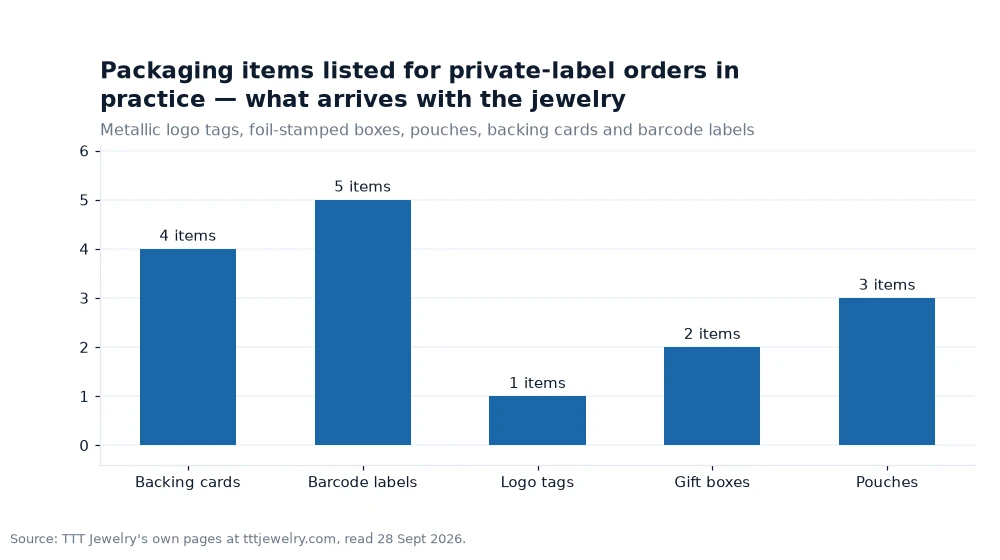
Packaging multiplies faster than plating. Five items are listed for private-label orders: logo tag, gift box, pouch, backing card and barcode label. One item of each per piece means 5 × 50 = 250 packaging components for that single design. Six designs at 50 pieces each would be 300 pieces and 6 × 250 = 1,500 components to source, count and match to the right SKU.
The calendar adds one more figure. Sampling at 25–30 days is 3.6–4.3 weeks and production at 3–4 weeks is 21–28 days, so with 2 days of CAD the order lands between 48 and 60 days from brief to dispatch. Plating sits inside the production window, not after it.
Frequently asked questions
Is rhodium plating better than gold plating on silver?
Neither is better in general. Rhodium gives a harder white surface that resists fine scratching, while gold gives warmth and colour, and the right choice depends on the look and the wear point.
Can plated silver jewelry be worn in the shower?
The published shower-safe claim covers 316L stainless steel with PVD plating. Plated silver has a metal deposit over a tarnish-prone core, so it should be kept away from prolonged water and chlorine.
Does an e-coat replace rhodium or gold?
No. The e-coat is a cured protective film applied over silver or brass, and it is used alongside a metal deposit or on its own for a silver-tone finish.
Matching the care card to the tank
The care instruction is part of the product. A rhodium piece, an 18K piece and an e-coated piece need three different sentences, and a single generic card is how a customer ends up cleaning a coated surface with an abrasive cloth.
Buyers who run several metals in one collection can keep the wording consistent by treating the finish as a field in the SKU record. The same discipline that governs custom brass jewelry applies to silver: name the substrate, name the stack, then write the care line from the stack.
For pieces that will be worn daily and exposed to water, the stainless steel jewelry manufacturer route with PVD is the honest comparison, because 316L carries 2–3% molybdenum and is built for that exposure. Silver stays the metal for colour and weight; the finish decides how long it keeps it.
Source note: figures come from the manufacturer's own website (tttjewelry.com), read 28 Sept 2026.[1]